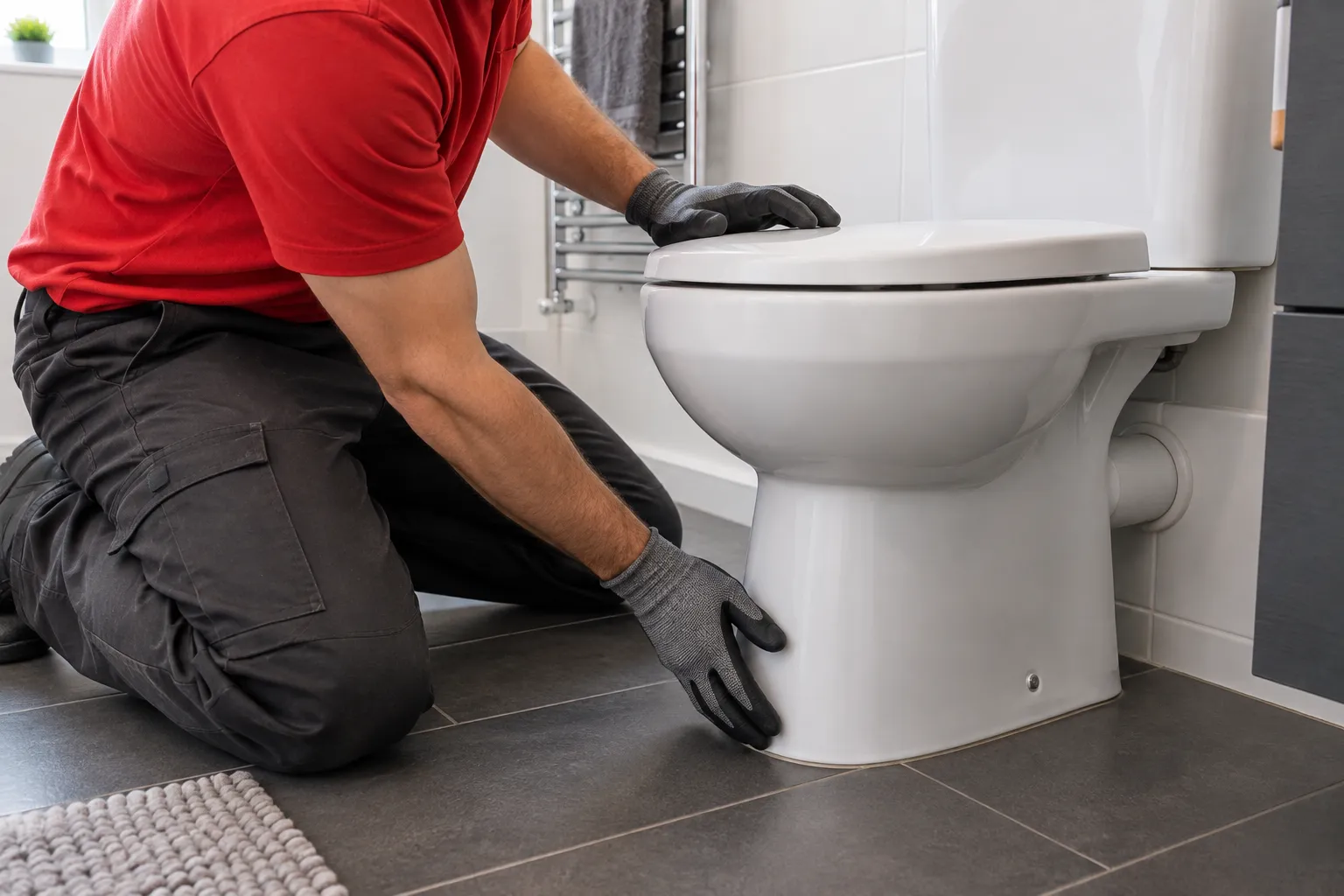
Stop adding water to a toilet that is backing up
If the bowl rises unusually and does not clear, stop flushing and keep it out of use. A slow drop in level does not establish that the obstruction has gone. Keep children and pets away from any overflow, and do not reach into contaminated water to retrieve an object that cannot safely be accessed.
If water is spilling near electrical equipment or into the ceiling below, report that immediately. Do not mix drain chemicals or add another product after one has failed. Tell the attending person what has been used so the clearance method accounts for it. A blocked toilet is a sanitation problem as well as a loss of convenience.
Locating the toilet blockage
We check whether the obstruction is confined to the pan or continues into its branch drain. The behaviour of other connected fixtures helps define the investigation: one slow toilet differs from several toilets and a shower backing up together. We use the accessible layout and observed drainage behaviour to direct clearance rather than repeatedly adding water.
Tell us if an object was flushed, if the blockage keeps returning or if the problem began after a toilet installation or refurbishment. A suspected foreign object needs an appropriate removal approach; a recurring fault can require the connection and downstream route to be investigated. We explain when the work needs to extend beyond the toilet itself.
Clearing the obstruction with agreed access
We select the approach around the pan, pipe condition, suspected obstruction and access available. A floor-mounted toilet with exposed connections differs from a wall-hung installation with concealed drainage. We assess whether clearance can use existing access and discuss removal of the pan or an alternative access point when needed.
If removal is necessary, the work includes consideration of fixings, seals and reinstatement of the toilet connection. We agree any disturbance to boxing or finished surfaces beforehand. Do not loosen or rock the pan yourself. Tell us about concealed pipework and the toilet model so the access discussion reflects the actual installation.
The cost depends on where the restriction lies, the clearance method, time required and whether the pan or concealed access must be opened. Replacement seals, damaged fittings and investigation farther along the drain are identified separately. We explain changes to the work before extending a local toilet clearance into a wider drainage investigation.
What happens after the obstruction is removed?
After clearing the blockage, we test controlled normal flushing and check the toilet and its accessible connections for leakage or instability. If the pan has been removed, its reconnection needs checking as well as the restored flow. We explain any separate defect found, including leakage at the base or movement of the toilet. If the bowl clears freely but the toilet is not flushing properly, the fault is in the cistern rather than the drain, and our guide on a toilet not flushing explains how to tell the two apart.
If the blockage returns, keep the dates and earlier findings. A recurring fault may justify investigating the branch drain or arrangement of the connection. A camera survey can be useful where the scope and access suit it, but it is not necessary for every one-off toilet blockage. Ask what unanswered question an additional survey would resolve.
Shared drains, blocks of flats and commercial toilets
Thames Water’s responsibility guidance distinguishes private drains from shared and public sewers. If neighbours have the same problem, involve the water company or managing agent before assuming that all work belongs within your flat. The toilet nearest the visible overflow is not automatically the source of a communal restriction.
For businesses, explain how many WCs remain available and whether public, staff or accessible facilities are affected. Arrange a site contact who can authorise work and access relevant rooms. Temporary closure and reopening decisions need to account for hygiene and the premises’ requirements, not just whether one test flush has succeeded. Where urinals are affected as well, our guide to a blocked urinal explains the difference between a scaled trap and a blocked shared drain.
Preventing the same problem without blaming the user
Thames Water advises flushing only human waste and toilet paper; wipes, sanitary items and other rubbish can obstruct pipes. Provide an appropriate bin and clear instructions where different people use the facilities. If a foreign object is suspected, describe it rather than trying repeated flushing to move it on.
Good use cannot correct every drainage defect. If ordinary use repeatedly causes a blockage, the condition and layout deserve investigation. Keep the explanation specific: what was found, what was removed, whether an underlying defect was observed and which next step is justified. That is more useful than a blanket recommendation to replace every drain.
Book the right toilet repair visit
Send the postcode, whether this is the only toilet, how high the water rises and which other fixtures are affected. Mention any chemicals used and previous clearance. The enquiry form accepts written details; photographs can be arranged by email if helpful and safe to take.
Loyal Plumbers operates 24/7 with 10 active vans across all London boroughs and inside the M25. We confirm the attendance and scope based on the current problem. If the toilet is leaking rather than blocked, our guide to water around the base helps describe the fault for a general plumbing repair.
Common questions
Should I keep flushing if the water slowly goes down?
No. A slow fall may indicate a partial restriction, and another flush can overflow the pan. Keep the fitting out of use until its condition is assessed.
Will the toilet need replacing?
Not automatically. Many blockages concern an obstruction or connected pipework. Replacement should have a clear reason, such as a damaged pan or an unsuitable installation.
Can you clear a toilet with concealed pipework?
Describe the design and any access panel. The method depends on what can be reached safely; opening finishes or moving the pan must be discussed before it is authorised.
Sources and further reading
Useful guides for this service
Explore all drainage and blockages guides →Need help with this in London?
Emergency repairs, investigations and planned installations across London and inside the M25. Tell us what you need so we can agree the next step.
Discuss your job